Table of Contents
About The Podcast
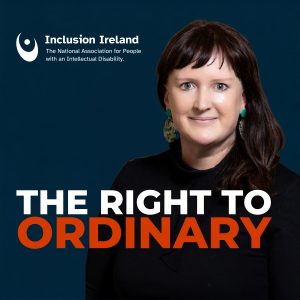
The Right to Ordinary Podcast
Real conversations about rights, inclusion and living an ordinary life.
A Right to Ordinary is Inclusion Ireland’s podcast exploring the issues that matter most to people with intellectual disabilities, families and supporters. Every episode breaks down complex topics into plain language, shares lived experience, and offers practical information you can use.
Why this podcast?
Knowledge is the first step towards power.
Too often, disability policy, legislation and services are explained using complicated language. That can leave people feeling confused or like decisions are being made for them.
A Right to Ordinary helps make these systems easier to understand.
Each episode explores one important topic through honest conversations with self-advocates, families and experts, helping listeners understand their rights, ask informed questions and make decisions with confidence.
Episodes
-
Episode 1
Available Now
Episode 1 – The Right to Ordinary Begins Here
In our first episode, we explore ableism – what it is, where it comes from, and how it continues to shape the lives of people with intellectual disabilities every day. Through honest conversation and powerful lived experience, we look at how discrimination can be built into our attitudes, language and systems, often creating unnecessary barriers to work, education, housing and decision-making.
Self-advocate Lydia Fisher shares her personal journey, from overcoming barriers to employment and learning to drive to regaining her right to make her own decisions after leaving Ward of Court. We also hear from Fiachra O’Connor, who explains how ableism shows up in society, why language matters, and what each of us can do to challenge discrimination.
Together, the conversation highlights why creating an Ireland where everyone can live an ordinary, self-directed life requires both personal reflection and systemic change
Key Topics
- Understanding ableism and how it affects everyday life
- The lasting impact of institutionalisation
- Employment and equal opportunities
- Supported decision-making and leaving Ward of Court
- Accessible systems and removing barriers
- The power of language and challenging stereotypes
- Becoming anti-ableist and creating inclusive communities
Resources:
-
Episode 2
Understanding Supported Decision-Making
About this episode:
Making decisions is something we all do every day, but for many people with intellectual disabilities, having their choices heard and respected has not always been guaranteed. In this episode, we explore the Assisted Decision-Making Act, what it means in practice, and why supported decision-making is about empowering people to lead their own lives – not taking families out of the picture.Derval is joined by Molly O’Keefe, founder of Positive Pathways and a long-time advocate for family leadership and inclusion.
Drawing on both her professional experience and her family’s journey, Molly shares practical examples of how people can be supported to make decisions in ways that reflect their own wishes, preferences and relationships.
We also hear from Fiachra O’Connor, who explains the Assisted Decision-Making Act in plain language, addresses common misconceptions, and outlines the practical supports available for people and families.
Together, the conversation highlights that good decision-making starts with relationships, trust and listening, ensuring every person has the opportunity to shape their own life and future.
Key topics
- What the Assisted Decision-Making Act means in practice
- Common myths and misunderstandings about the legislation
- The important role of families and natural supports
- Supporting people to express their will and preferences
- Everyday and major life decisions
- Practical tools, including communication passports and vision planning
- How to access information and support through the Decision Support Service (DSS)
Resources:
-
Episode 3
Episode 3 – The Cost of Exclusion: Why Does Being Disabled Cost More?
Why should it cost more to live an ordinary life simply because you are disabled?
Disabled people often face additional costs for things that non-disabled people can take for granted – from transport, heating and housing to medication, therapies, equipment and taking part in everyday life.
But are these really the costs of disability? Or are many of them the costs of exclusion – created by inaccessible services, systems and communities?
In this episode of The Right to Ordinary, Derval McDonagh explores the real impact these additional costs have on disabled people and their families, and why this is about much more than money.
We hear about the difficult choices people can be forced to make when there isn’t enough money to meet basic needs, and how additional costs can lead to poverty, loneliness, isolation and exclusion from community life.
The conversation also looks at the bigger picture: inaccessible transport and housing, barriers to employment, gaps in disability supports and a social welfare system that can restrict people’s choices and independence.
Derval is joined by disability advocate Amy Hassett, co-founder and co-chairperson of Disabled Women Ireland, who explains why the cost of exclusion is fundamentally a human rights and equality issue.
We also hear from our resident Human Rights Advocate Fiachra O’Connor, who discusses the structural inequalities facing people with intellectual disabilities and what needs to change.
With Budget 2027 approaching, the episode asks what Government must do next – including introducing a permanent payment that reflects the real additional costs disabled people face, while also tackling the systems and barriers that create those costs in the first place.
Because the goal shouldn’t simply be to help disabled people pay for exclusion. It should be to remove the barriers that create it.
In this episode
We discuss:
- What we mean by the cost of exclusion
- The additional everyday costs disabled people can face
- How inaccessible housing, transport, services and workplaces create additional costs
- The link between disability, poverty and social exclusion
- Why this is a human rights and equality issue
- The impact of current social welfare rules and supports
- What a permanent Cost of Disability payment should look like
- Why any new payment must be designed with disabled people
- What Government and wider society need to change
- How people can make their voices heard ahead of Budget 2027
Take action
Budget 2027 is an opportunity for Government to take meaningful action on the cost of exclusion.
Inclusion Ireland is calling for a permanent Cost of Disability payment that reflects the real additional costs disabled people face. This must be part of wider action to remove the barriers that prevent disabled people from participating equally in everyday life.
You can help by contacting your local TD and asking them to support action on the cost of exclusion in Budget 2027.
Follow The Right to Ordinary wherever you get your podcasts to hear future episodes, and share this episode with someone who needs to hear this conversation.
Resources
Our Rights, Our Voices – Inclusion Ireland’s Pre-Budget Submission for 2027
Our Rights, Our Voices – Easy-to-Read Version
Have Your Say on Budget 2027 campaign resources
Find your local TD’s details at ContactMyTD.ie
Cost of Disability public consultation submission – Video Explainer
Benefits for people who are sick or have a disability – Citizens Information
Factsheet: Cost of Disability – Disability Federation of Ireland
-
Episode 4 - A Home of Your Own: Choice, Control and Planning for the Future
What does it really mean to have a home of your own?
In the first of our two-part housing special, we hear from Paul Alford, a long-time self-advocate and member of the Inclusion Ireland team, about his journey from institutional living to having a home and life of his own.
Paul spent more than 32 years living in institutions, where many everyday decisions — from when he ate to how he spent his money and where he could go — were controlled by others. In 2016, after years of advocating for himself, Paul moved into his own home.
Paul talks openly about the excitement — and challenges — of getting the key to his own front door, learning to live independently, building connections in his community and choosing the support that works for him.
We also speak to Fiachra O’Connor, Human Rights Advocate with Inclusion Ireland, about some of the barriers people with intellectual disabilities and their families face when trying to plan for future housing and supports.
Fiachra discusses why planning early matters, the importance of starting conversations about future housing before a crisis happens, applying for social housing support and finding out what supports are available locally.
Most importantly, this episode explores a simple idea: independent living does not mean doing everything by yourself. It means having choice and control over where you live, who you live with, how you live your life and the support you receive.
In this episode
We discuss:
- Paul’s experience of living in an institution for more than three decades
- His fight to move into a home of his own
- What having his own front-door key meant to him
- Choosing his own support and learning new skills
- Building friendships, relationships and connections in his community
- Why independent living doesn’t mean living without support
- The barriers facing people with intellectual disabilities who want to plan for their future
- Why families should begin conversations about future housing early
- Where to start when looking for housing and supported-living options
Useful Resources
Inclusion Ireland – Housing Resources
Our housing hub brings together information for people with intellectual disabilities and families about independent living, housing with supports, service models, funding, finding residential services and starting to plan for the future.
Explore Inclusion Ireland’s Housing ResourcesThe Right to an Ordinary Life: Choice, Belonging and Community Living
Inclusion Ireland’s resource explores what genuine community living looks like and introduces our Three Choice Test:Do I have a choice about where I live?
Do I have a choice about who I live with?
Do I have a choice about how I spend my time?Read The Right to an Ordinary Life and our housing resources
Housing and Supported Living – Inclusion Ireland
Find out more about Inclusion Ireland’s work to make the right to independent living and community inclusion a reality for people with intellectual disabilities.
Housing and Supported Living campaignApplying for Social Housing Support
Information from the Department of Housing on eligibility for social housing support, how applications are assessed and how to apply through your local authority.
Applying for Social Housing Support – Gov.ieA good place to start
If you or someone you support is thinking about future housing, don’t wait until a crisis happens to begin the conversation.
Think about what a good life would look like, explore housing options with your local authority, talk to your service provider or local HSE disability service about the supports you may need, and make sure the person at the centre of the conversation has a real say in the decisions being made.
A home is about much more than an address. It is about choice, belonging, relationships and having the support you need to live your life on your own terms.
-
Episode 5 - Beyond the Front Door - What Real Community Living Looks Like
Moving out of an institution and into a house in the community does not, by itself, create inclusion.
In the second part of our housing special, Selina Doyle, Director of Strategic Development at Aurora, joins Derval McDonagh to explore what it really takes to move from institutional models of care towards genuine community living, belonging and citizenship.
Selina has more than 40 years’ experience working alongside disabled people and their families. She shares the story of Aurora’s transition from its former campus-based institutional model, where 92 adults with disabilities lived, towards supporting people to live in homes within their communities.
The conversation explores the complexity of that change – for disabled people themselves, for families and for staff – and some of the lessons learned along the way.
But Selina makes an important distinction: the house is only the beginning.
Real community living is about relationships, belonging and being known and valued in your community. It is about moving beyond simply being present in a community to participating, contributing, forming relationships and being recognised as a fellow citizen.
In this episode
We discuss:
- The history of institutional and congregated living
- Aurora’s journey from a campus-based model to community living
- Why moving into a house in the community isn’t enough
- Listening to a person’s will and preferences when planning where and how they live
- Supporting families through major change
- How the role of staff needs to change in community-based support
- The difference between taking part in activities and genuinely belonging
- Building friendships and relationships with people who are not paid to be in someone’s life
- Why relationships can be an important part of safety
- Supporting positive risk-taking
- Preventing institutional practices from simply following people into smaller community settings
- What Government, services and communities need to do differently
Selina also identifies some of the system changes needed to make genuine community living possible: clearer expectations about the models of support the State funds, investment in workforce skills, greater public understanding of disabled people’s right to citizenship and dedicated funding for the intentional work needed to build community connections and belonging.
Housing and community-living resources
Inclusion Ireland – Housing Resources
Information and resources for people with intellectual disabilities and families about independent living, housing with supports, service models, planning for the future and finding the right supports.
Explore Inclusion Ireland’s Housing ResourcesThe Right to an Ordinary Life: Choice, Belonging and Community Living
Our resource looks beyond bricks and mortar to ask what real community living should mean for people with intellectual disabilities.At its heart is Inclusion Ireland’s Three Choice Test:
Do I have a choice about where I live?
Do I have a choice about who I live with?
Do I have a choice about how I spend my time?Read The Right to an Ordinary Life and our housing resources
Housing and Supported Living – Inclusion Ireland
Learn more about the right to live independently and be included in the community under Article 19 of the UN Convention on the Rights of Persons with Disabilities, and Inclusion Ireland’s priorities for change.
Housing and Supported Living campaignApplying for Social Housing Support
Official information about applying to your local authority for social housing support.
Applying for Social Housing Support – Gov.ieHSE Adult Disability Residential Services
Information about residential supports for disabled adults and how to contact disability services in your local area.
HSE Adult Disability Residential ServicesWhat does real community living look like?
It isn’t simply moving from a large institution to a smaller building.
It means having real choices about where and with whom you live. It means having relationships, being known by your neighbours, joining ordinary community spaces, contributing, making decisions and having the right support to build the life you want.
Because the goal shouldn’t simply be to provide people with places to live. It should be to support people to have homes, relationships, choices and lives of their own.
-
Episode 6 - Coming Soon
Relationships, Love and Belonging
Exploring friendships, relationships and challenging stereotypes
Ask a Question
Podcast
"*" indicates required fields